Alerts that stay the same
A threshold fires, and keeps firing, whether the disturbance is dying out or building into a cascade. Operators see the alarm but not the direction.
Structural resilience intelligence
ARPA reads the structure and the trajectory of complex systems, from power grids to railways to financial markets. It tells operators whether a disturbance will fade, recover or cascade, early enough to act. The same core works in any industry and is configured around your operations.
Most monitoring answers one question: what is the state right now? In a connected system that is not enough, because two systems with identical readings can be heading to opposite outcomes.
A threshold fires, and keeps firing, whether the disturbance is dying out or building into a cascade. Operators see the alarm but not the direction.
By the time a headline metric degrades, the structural damage is already done. The useful signal arrived earlier, in how the system was changing.
Each sector builds its own models and thresholds, tuned to the past. They break the first time the system behaves in a way it never has.
ARPA measures how a system is connected and how that connectivity is changing. Its classification follows from that geometry, not from rules written for one industry.
Every assessment combines where the system stands with where it is moving. A snapshot is never enough on its own.
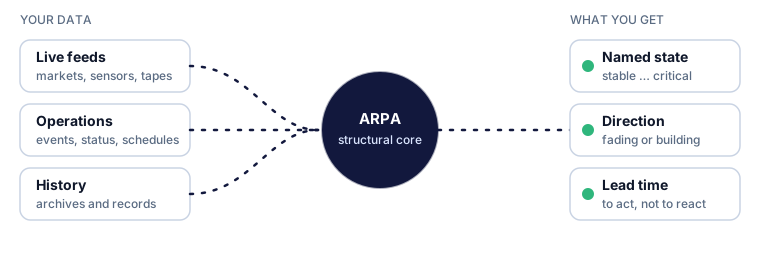
The core holds no industry knowledge and no tuned cut-offs. Each state is where the system sits, and which way it is moving, relative to a boundary that follows from its own structure, such as the point where a cascade starts to sustain itself.
The output is a named condition an operator can act on, not a number to interpret.
The structural core is identical in every deployment. Only the outer layers change, which is why ARPA can be fitted to a new industry without being rebuilt.
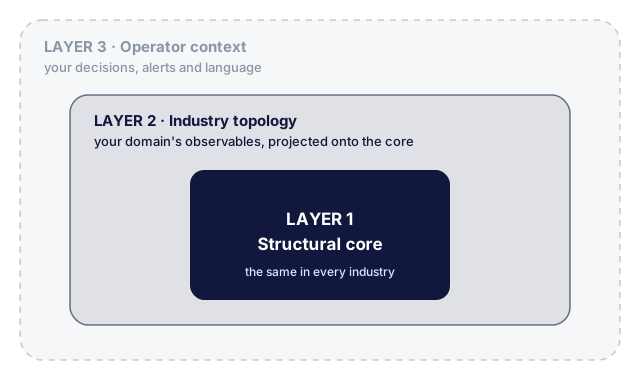
A pure, industry-agnostic classifier. It works on 13 geometric primitives that describe pressure, trajectory, reserves and feedback in any connected system.
Translates the observables of a domain, such as train movements, grid flows or lending positions, into those primitives.
Gives each state its meaning for you: your alerts, your vocabulary, your decisions and your dashboards.
There is no fixed product to squeeze your operations into. We start from what you need to see and decide, and configure the core around it.
We learn your domain, your data sources and the decisions you need to make faster.
Your observables are projected onto the structural core, with the sources documented and checked.
The solution is configured and delivered through the dashboards, feeds and alerts your team already works with.
The system runs on live data. Findings are reviewed with you, and the setup is refined as you learn what matters.
Any industry where parts depend on each other and a local failure can spread.
Tell us your industry and what you need to see sooner. We will come back with how ARPA would be configured for it.